When a patient goes into cardiac arrest, there is no time to second-guess the next step. Advanced Cardiovascular Life Support training exists precisely for those moments — to ensure that the providers in the room can move quickly, communicate clearly, and execute the right interventions without hesitation. For healthcare professionals in Kansas City, ACLS certification is not just a credentialing requirement. It is the foundation of clinical readiness in high-stakes emergencies. CPR Kansas City is a trusted American Heart Association training site that delivers ACLS certification through a hands-on, stress-free learning experience specifically designed to build the kind of confidence that holds up under real pressure.
What Is ACLS Certification and Who Needs It?
Advanced Cardiovascular Life Support is a structured AHA training program that prepares healthcare providers to manage complex cardiac and respiratory emergencies. It builds on Basic Life Support foundations and introduces the advanced clinical competencies required to lead or contribute effectively during a code. ACLS is the recognized standard for providers working in environments where patients are at the highest risk for life-threatening cardiovascular events.
Core skills addressed in ACLS training include:
- Cardiac rhythm recognition — identifying shockable and non-shockable rhythms, bradycardia, tachycardia, and arrest patterns on ECG
- Advanced airway management — bag-mask ventilation, supraglottic airway placement, and ventilation strategy during resuscitation
- Pharmacology in emergencies — understanding the indications, dosing, and timing of epinephrine, amiodarone, atropine, and other resuscitation medications
- Team dynamics and communication — applying closed-loop communication, defined team roles, and effective leadership during a resuscitation event
Healthcare professionals who are most commonly required to hold current ACLS credentials include nurses and nurse practitioners, physicians and residents, paramedics and advanced EMTs, respiratory therapists, and emergency response team members. Most hospitals and health systems require ACLS certification as a condition of employment or credentialing for any role that may involve responding to a cardiac arrest.
Why Confidence Matters in ACLS Situations
There is an important distinction between understanding a protocol and being able to execute it under pressure. A provider can memorize the cardiac arrest algorithm and still hesitate at the bedside when a real code begins. That hesitation has consequences. In cardiac arrest, every minute without high-quality CPR or defibrillation reduces the probability of survival. A provider who acts immediately and correctly — because they have rehearsed the scenario enough times to respond from muscle memory — is a meaningfully different clinical asset than one who knows what to do in theory.
Call Us Now
Get the Best CPR Class in Kansas City Today!
Confidence improves outcomes across every dimension of the resuscitation response. A confident team leader assigns roles clearly, communicates without ambiguity, and keeps the resuscitation moving at the pace the patient needs. Confident team members perform compressions at the correct depth and rate, operate the defibrillator without delay, and administer medications accurately. Research published in Resuscitation and related journals consistently demonstrates that team confidence and coordination are among the strongest predictors of return of spontaneous circulation (ROSC) in both in-hospital and out-of-hospital cardiac arrest.
Confidence is not a personality trait — it is a training outcome. It is built through repetition, realistic simulation, and the experience of performing skills correctly in a supported environment.
What Makes CPR Kansas City ACLS Training Different
CPR Kansas City approaches ACLS training as a skill-development experience rather than a certification transaction. Every aspect of the program is designed to produce providers who can perform, not just providers who can pass a test.
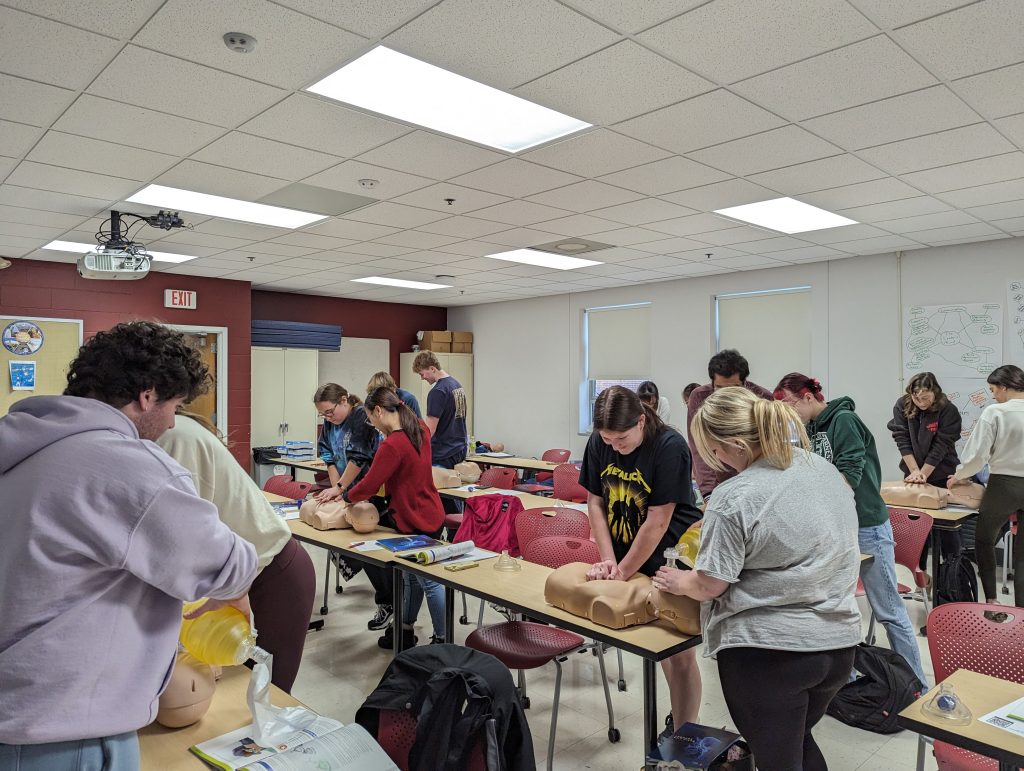
The training methodology is hands-on and scenario-based from the start. Participants spend the majority of class time working through simulated emergency scenarios rather than sitting through extended lectures. This active approach mirrors the clinical environments providers work in and ensures that skills are developed through doing rather than watching. The learning environment is intentionally stress-free — not because the content is softened, but because anxiety impedes learning. When participants feel supported rather than evaluated, they take more risks, ask more questions, and retain more information.
Instructors at CPR Kansas City are AHA-certified professionals with real-world clinical and emergency response experience. They bring practical insight to every scenario, offer immediate and specific feedback on technique, and adjust their approach to meet each participant’s starting point. Class sizes are kept small to ensure that this level of individualized attention is consistently available throughout the session.
Key Features of ACLS Classes in Kansas City
High-Fidelity Simulations
ACLS training at CPR Kansas City uses realistic emergency scenarios that replicate the conditions providers encounter in actual clinical settings. Participants practice with defibrillators and advanced airway equipment, working through the full sequence of a resuscitation response — from initial recognition to post-arrest care. High-fidelity simulation has been shown in multiple medical education studies to produce significantly better skill retention and clinical performance than low-fidelity or didactic-only training formats.
Team-Based Training
Cardiac arrest response is inherently a team event. ACLS training at CPR Kansas City reflects that reality by placing participants in defined team roles during mock code scenarios. Providers practice as team leaders, compressors, airway managers, and medication administrators — rotating through roles to develop competency and perspective across the full resuscitation team structure. Emphasis is placed on clear communication, role acknowledgment, and the kind of coordinated response that leads to better patient outcomes.
Same-Day AHA Certification
Participants who complete the ACLS course receive their American Heart Association certification card the same day. The card is valid for two years and meets the requirements of hospitals, health systems, credentialing boards, and employers throughout Kansas City and nationwide. Same-day certification eliminates the logistical uncertainty of waiting for mailed credentials and ensures providers can meet compliance deadlines without delay.
Flexible Scheduling Options
CPR Kansas City offers weekday and weekend class options designed to accommodate the demanding and variable schedules of healthcare professionals. Shift workers, residents, and providers managing complex personal and professional commitments can find a class time that fits without sacrificing days off or disrupting clinical coverage.
Skills You Will Master in ACLS Training
ACLS training at CPR Kansas City produces providers who are competent and confident across the full scope of advanced cardiac emergency response:
- Advanced airway management — correct technique for bag-mask ventilation, airway adjunct placement, and ventilation rate during CPR
- ECG rhythm interpretation — rapid and accurate identification of shockable rhythms, non-shockable rhythms, and peri-arrest arrhythmias
- Medication administration in resuscitation — indications, dosing, timing, and routes for epinephrine, amiodarone, and other critical agents
- High-quality CPR and defibrillation — compression fraction optimization, preshock pause minimization, and safe shock delivery
- Post-cardiac arrest care — recognition of ROSC, targeted temperature management considerations, and handoff communication
These competencies are not reviewed in isolation. They are practiced together in integrated scenarios that require participants to apply multiple skills simultaneously — exactly as they would in a real resuscitation event.
How Hands-On Training Builds Real Confidence
The mechanism by which hands-on training builds confidence is well established in both medical education research and cognitive science. Learning by doing activates different neural pathways than passive observation or reading. When a skill is physically practiced repeatedly, it becomes encoded in procedural memory — the same memory system that governs automatic, fluent performance. Providers who have physically worked through ventricular fibrillation management a dozen times in training do not have to consciously reconstruct the algorithm when they encounter it clinically. They respond.
Immediate instructor feedback accelerates this process. When a participant performs a skill incorrectly, real-time correction prevents the reinforcement of bad technique. When they perform it correctly, specific positive feedback reinforces the right pattern. This cycle of practice, feedback, and correction is what separates hands-on certification from online-only alternatives, which cannot replicate the physical and interpersonal dimensions of skill development.
The stress-free environment at CPR Kansas City is not incidental — it is a deliberate feature of effective training design. Research in educational psychology consistently shows that psychological safety improves learning outcomes. When participants are not afraid of judgment or failure, they engage more fully, practice more willingly, and retain more completely.
Benefits of Choosing Local ACLS Training in Kansas City
Choosing a local ACLS training provider offers practical advantages that extend beyond convenience. Kansas City-area providers who train locally benefit from:
- Reduced travel time and cost — no need to commute to regional training centers or take additional time away from work
- Familiarity with local healthcare standards — instructors who understand the clinical environment and employer expectations of Kansas City health systems
- Networking opportunities — training alongside other local healthcare professionals creates connections that extend into the broader clinical community
- Scheduling alignment — local providers with flexible class times are better positioned to accommodate the specific scheduling constraints of Kansas City healthcare workers
For providers renewing expiring credentials or completing initial certification ahead of a new role, local access removes friction from the process and makes compliance straightforward.
Conclusion
ACLS certification is one of the most consequential credentials a healthcare professional can hold — and the quality of the training behind that certification determines whether it translates into real performance when a patient’s life is on the line. CPR Kansas City delivers ACLS training that goes beyond checking a compliance box, producing providers who are genuinely prepared to lead and contribute in high-stakes cardiac emergencies. Ready to train with confidence? Book your ACLS or BLS class today. Whether you’re seeking CPR Certification in Kansas City or ACLS Certification in Kansas City, CPR Kansas City has flexible scheduling to fit your busy life. Visit us and take the next step in saving lives.
FAQs
Q1: What makes CPR Kansas City’s ACLS training different from other providers? CPR Kansas City is an American Heart Association-authorized training site that emphasizes hands-on, stress-free learning. Rather than rushing through slides, students practice real-world emergency scenarios that build genuine clinical confidence — not just test-taking skills.
Q2: Do I need prior experience before taking an ACLS course in Kansas City? A basic understanding of CPR and cardiac rhythms is recommended before enrolling in ACLS. CPR Kansas City also offers BLS for Healthcare Providers, which is an excellent foundation if you need to strengthen your core skills before stepping into an ACLS course.
Q3: How long does ACLS certification last, and can I renew it at CPR Kansas City? ACLS certification is valid for two years. CPR Kansas City offers both initial certifications and renewals, making it easy for healthcare professionals to stay current with their credentials without the stress of starting from scratch.


